For most Arkansas homeowners seeking lasting beauty, low lifecycle maintenance, and genuine architectural character, natural stone is the superior hardscape choice for patios and high-visibility outdoor spaces. Properly engineered stamped concrete remains a practical alternative when initial budget, pattern consistency, or installation speed matters most. The final decision, however, must account for Arkansas clay soil, heavy rainfall, hot humid summers, and recurring freeze-thaw cycles, not simply the material’s appearance on installation day.
Arkansas Weather Demands More Than a Beautiful Surface
Arkansas has a humid subtropical climate with hot summers, cool winter periods, abundant rainfall, and frequent severe storms. Statewide precipitation commonly falls within an approximate 40- to 60-inch annual range, with winter and spring often bringing prolonged wet periods and intense rainfall.Arkansas climate summary
Those conditions place continuous stress on hardscape construction. Many Arkansas properties also contain clay-rich soils that expand when wet and shrink as they dry. During winter, moisture can freeze within the soil and construction materials, then expand and contract through repeated freeze-thaw cycles.
A durable patio or driveway therefore depends on more than the visible finish. It requires:
- Proper excavation and subgrade preparation
- A well-compacted aggregate base
- Positive drainage and carefully planned slopes
- Appropriate jointing and edge restraint
- Materials selected for moisture, heat, and movement
- Installation by professionals who understand local ground conditions
A premium material installed over a weak base can fail. A modest material installed with precision can perform respectably. Craftsmanship and engineering are inseparable.
Natural Stone Offers Enduring Beauty and Repairability
Natural stone, such as Arkansas fieldstone, flagstone, limestone, granite, or carefully selected regional stone, offers a character that manufactured surfaces can imitate but never fully reproduce. Each piece carries its own grain, mineral variation, edge, and tonal depth.
For a custom patio design in Arkansas, this individuality creates an outdoor room that feels integrated with the property rather than added onto it. Stone can echo the architecture of a historic home, soften a contemporary residence, or provide a tranquil transition between gardens, terraces, pools, and outdoor kitchens.

Natural stone also offers important practical advantages:
- Individual pieces can be lifted and reset. Localized movement does not necessarily mean replacing an entire patio.
- Color is inherent to the material. Natural mineral tones generally age more gracefully than surface-applied pigments.
- The surface develops a patina. Weathering often adds depth and distinction rather than making the material look obsolete.
- Stone can be cooler and more comfortable. Surface temperature varies by stone type, color, shade, and orientation, but many homeowners find natural stone more pleasant underfoot than dark stamped concrete in direct summer sun.
- The design is inherently bespoke. Hand-selected stones create organic coursing, borders, steps, walls, and focal details that are difficult to duplicate.
Natural stone does cost more initially because the investment includes premium material, detailed base preparation, and the labor of master artisans. It is not simply a product purchase. It is a crafted installation.
Stamped Concrete Delivers Value and Design Flexibility
Stamped concrete begins as poured concrete and is textured or patterned to resemble slate, flagstone, brick, tile, or other surfaces. Integral color, stains, release agents, and sealers can create a polished appearance at a lower initial cost than many hand-laid stone installations.
For homeowners researching stamped concrete Arkansas projects, the material makes sense when:
- A predictable color and pattern are important
- The project covers a large area
- The budget favors a lower upfront investment
- A continuous surface is preferred
- The homeowner accepts periodic resealing and eventual repairs
- The design calls for a clean, contemporary, or highly uniform finish
Stamped concrete can be particularly effective for an entertainment patio, pool surround, walkway, or driveway where visual continuity and cost control are priorities. It can also be combined with natural stone accents, masonry walls, steps, or borders to create a more elevated composition.
The important distinction is that stamped concrete is still concrete. Its decorative pattern does not eliminate the material’s vulnerability to cracking, surface scaling, color fading, or joint-related movement.

Natural Stone vs. Concrete: A Practical Comparison
| Consideration | Natural Stone | Poured or Stamped Concrete |
|---|---|---|
| Initial cost | Higher, especially with custom craftsmanship | Generally lower |
| Expected service life | Often 30–50+ years when properly designed and installed; some installations last much longer | Commonly 10–20+ years before major repair or replacement, depending on base, drainage, use, and maintenance |
| Arkansas clay movement | Segmental systems can be reset piece by piece | Large slabs can develop visible cracks when soil movement is significant |
| Freeze-thaw performance | Strong when the selected stone and installation method are appropriate | Requires sound mix design, drainage, control joints, and ongoing maintenance |
| Color | Natural mineral color ages with distinction | Pigments and stains can fade over time |
| Maintenance | Sweeping, rinsing, joint care, and optional sealing depending on the stone | Regular cleaning and resealing; repairs may be more visible |
| Design character | Organic, singular, and artisanal | Consistent, patterned, and highly customizable |
| Repairs | Individual stones can often be replaced or reset | Cracks and patches may remain visible |
| Resale appeal | Strong premium and architectural impression | Attractive when well-designed and maintained |
| Best application | Legacy patios, terraces, steps, walls, and focal areas | Budget-conscious patios, broad driveways, and uniform contemporary designs |
Cost varies significantly by access, excavation, drainage, stone selection, reinforcement, grading, pattern complexity, and project scale. As a broad planning principle, stamped concrete may cost substantially less upfront than custom natural stone, while natural stone can deliver a lower cost per year of service when it remains functional and beautiful for decades.
Patios: Where Stone Usually Creates the Greater Legacy
A patio is experienced at close range. Homeowners walk across it barefoot, gather around a fire, dine outdoors, and see it from interior rooms throughout the year. These intimate experiences make texture, temperature, visual variation, and aging especially important.
For a concrete patio Arkansas homeowners may prefer stamped concrete when they want:
- A controlled installation budget
- A uniform surface
- A decorative pattern without individual stone placement
- A practical foundation for furniture and outdoor dining
- A coordinated color palette with the home
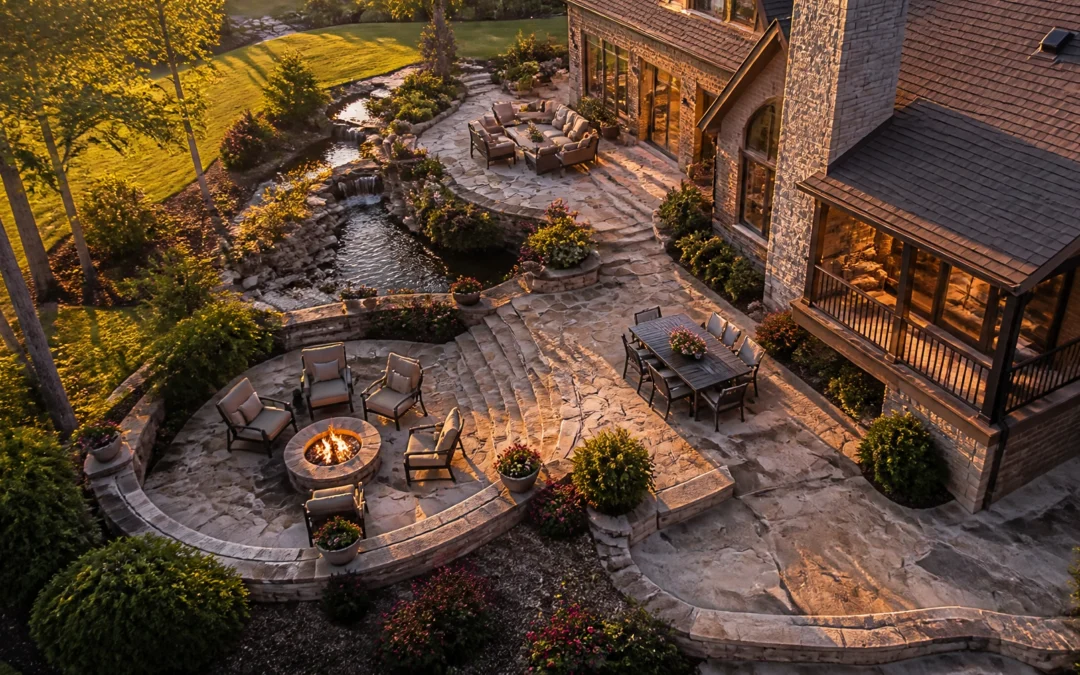
Natural stone is often the stronger choice when the patio is intended to become a defining architectural feature. A hand-fitted flagstone terrace, stone stairway, or masonry-framed outdoor room can gain presence over time. It does not need to imitate another material; it possesses its own quiet authority.
Explore examples of outdoor transformations in our project gallery.
Driveways: Concrete Is Practical, but Preparation Is Non-Negotiable
Driveways must withstand vehicle loads, turning forces, water runoff, and repeated seasonal movement. Properly reinforced concrete can be a sensible and economical choice for large driveway areas, particularly when the design favors a clean and continuous surface.
Stamped concrete can add distinction to a driveway, but it demands disciplined installation and maintenance. Control joints, drainage, subgrade compaction, reinforcement, and surface sealing all influence performance. A decorative finish cannot compensate for poor preparation.
Natural stone can be used successfully for driveways, but not every flagstone or irregular stone is appropriate for vehicular traffic. Vehicle-rated stone pavers or thick, dense units installed over an engineered base are the appropriate approach. The investment is higher, but localized repairs are often more manageable than replacing a large concrete slab.
For many properties, a thoughtful hybrid design is the most intelligent solution: concrete for the primary driveway field, with natural stone borders, entry piers, steps, or a formal apron. This balances cost, performance, and architectural prestige.
Maintenance, Longevity, and the True Cost of Ownership
Stamped concrete typically requires resealing every few years to protect color and reduce water intrusion. In Arkansas, that maintenance is especially important because heavy rainfall, intense summer sun, and winter temperature changes can accelerate surface wear.
Cracks may result from drying shrinkage, soil movement, inadequate control joints, drainage problems, or freeze-thaw stress. Some cracks can be repaired successfully, but color matching and texture matching are not always invisible.
Natural stone generally requires simpler care: sweeping, occasional rinsing, attention to joints, and sealing when recommended for the specific material and desired appearance. If settlement occurs, a skilled installer may remove, re-bed, and reset affected pieces rather than demolishing the entire surface.
The most important long-term investment is concealed beneath the hardscape. A properly constructed base and drainage system protect both stone and concrete from Arkansas’s wet-dry soil cycles.
Learn more about our landscaping and hardscape construction services, including retaining walls, outdoor kitchens, French drains, design drawings, and related landscape construction.
Why Master Stone Masons Often Recommend Stone for Legacy Properties
Our master stone masons recommend natural stone for legacy properties because it offers more than durability. It offers permanence of expression.
Concrete can be efficient, attractive, and appropriate. Stone, when selected and placed with discernment, becomes part of the property’s identity. It connects the architecture to the land, accommodates organic planting, and develops a patina that reflects time rather than fighting it.
That distinction matters to homeowners who are not merely filling an outdoor area but shaping the setting for decades of family life. The work must function first, then create an atmosphere of elegance, beauty, and tranquility.
The right material is ultimately the one that aligns with your property, priorities, and intended lifespan. We will recommend stamped concrete when it genuinely serves the design. We will recommend stone when the project calls for a more enduring and expressive result.
Frequently Asked Questions
Is natural stone better than stamped concrete in Arkansas?
For long-term beauty, repairability, and architectural character, natural stone is generally the premium choice. Stamped concrete can perform well when installed over a properly prepared base and maintained with regular resealing, but it is more likely to show cracking, fading, or surface wear over time.
How much does concrete work cost in Fayetteville, AR?
Concrete work in Fayetteville depends on square footage, excavation, access, reinforcement, drainage, finish, and site conditions. Plain concrete is usually less expensive than stamped concrete, while custom stone typically requires a larger initial investment. A site-specific consultation is the most reliable way to establish a project range.
Is stamped concrete suitable for Arkansas weather?
Yes, stamped concrete can be suitable for Arkansas when the contractor addresses clay soil, drainage, reinforcement, control joints, concrete mix, curing, and sealing. It should be selected with the understanding that maintenance and future repairs are part of ownership.
What is the best material for a concrete patio in Arkansas?
If the priority is a lower initial cost and a consistent decorative finish, stamped concrete is a practical option. If the priority is a distinctive, long-lived outdoor room with natural character, properly installed stone is usually the stronger choice.
Can natural stone be used for an Arkansas driveway?
Yes, but the stone must be appropriate for vehicular loads and installed over an engineered, well-compacted base with effective drainage. Vehicle-rated stone pavers or thick dense units are preferable to thin or irregular patio flagstone.
Does natural stone increase home resale value?
A well-designed natural stone patio, entry, or driveway can strengthen a property’s perceived quality and architectural appeal. It does not guarantee a specific return, because resale value also depends on neighborhood standards, workmanship, maintenance, and overall design coherence.
Begin with the Right Material and the Right Foundation
Your hardscape should do more than survive Arkansas weather. It should enrich the architecture, guide the landscape, and become more compelling with time.
We invite you to contact Architectural Landscape Construction LLC to discuss your patio, driveway, or complete outdoor room. For additional design insight and master-crafted resources, visit the Legacy Storefront.
Architectural Landscape Construction: Legacies in stone since 1987.
Recent Comments