For most Arkansas landscapes, the smarter investment depends on the role the stone must perform. Full-depth natural stone masonry is the stronger choice for structural, heavily exposed, or load-bearing features. Manufactured stone veneer can be an elegant and appropriate choice for vertical cladding when it is installed over a properly engineered substrate with disciplined moisture management. The right decision is not simply about appearance or initial cost. It is about soil, drainage, exposure, structural demands, craftsmanship, maintenance, and the long-term character you want your property to express.
At Architectural Landscape Construction LLC, we approach every project as both a construction challenge and an artistic commission. Our team includes two of Arkansas’s few true master stone masons, combining traditional craftsmanship with innovative design while serving Arkansas since 1987.
Natural Stone and Stone Veneer Serve Different Purposes
Full-depth natural stone masonry uses substantial stone units, often fieldstone, flagstone, limestone, sandstone, or other regionally appropriate materials, to create walls, piers, steps, patios, fireplaces, and architectural features. Depending on the design, the stone may function as a structural masonry system, a substantial facing, or part of a reinforced assembly.
Manufactured stone veneer is a thinner, lighter cladding product designed to reproduce the appearance of natural stone. It is commonly installed over concrete masonry, framed walls, outdoor kitchen structures, fireplace assemblies, or other properly prepared substrates.
Veneer is not automatically inferior, and natural stone is not automatically appropriate for every application. Veneer can provide a beautiful finish on a vertical architectural element. Natural stone is generally better suited to places where the material must withstand concentrated loads, ground pressure, repeated foot traffic, or extensive weather exposure.
The wiser investment is the material and installation system that match the function.
Arkansas Conditions Make the Installation System Essential
Arkansas landscapes experience hot, humid summers, abundant precipitation, heavy rain events, and periodic winter freezes. The NOAA Arkansas State Climate Summary describes year-round precipitation, a long-term statewide annual average of approximately 50.1 inches, and occasional heavy rainfall exceeding 10 inches.
Those conditions place continuous demands on outdoor construction. Water moves through soil, behind walls, into joints, across patios, and around vertical cladding. Many properties also contain clay-rich or expansive soil layers that can shrink when dry and swell when wet. That movement can contribute to settlement, heaving, and lateral pressure if a project is built directly on unsuitable native soil.
Freeze-thaw cycles add another concern. Water that enters porous materials, mortar joints, or concealed voids can expand when temperatures fall and contract as conditions warm. Repeated wetting and drying can also contribute to efflorescence, staining, biological growth, and deterioration of poorly detailed surfaces.
For both natural stone and veneer, longevity begins below and behind the visible finish.

Retaining Walls Require Structural Judgment
For retaining walls in Arkansas, full-depth natural stone masonry or another engineered structural system is typically the more appropriate direction when the wall must resist soil pressure, support a change in grade, or manage significant water movement.
A successful retaining wall may require:
- A stable, properly prepared base
- Site-specific evaluation of soil and slope
- Compacted granular backfill
- A drainage system, such as perforated pipe and clean stone
- Appropriate reinforcement or structural support
- Wall caps that shed water away from the face
- Safe discharge for collected water
A thin veneer can be used as a decorative face over a structurally adequate retaining wall, but it should not be treated as the retaining system itself. Applying veneer directly to an unstable or poorly drained wall only conceals the problem.
On sloped Arkansas properties, the visible stone is only one part of the design. The unseen foundation, drainage, grading, and backfill determine whether the finished feature performs as intended.
Patios Demand Stable Bases and Careful Material Selection
A custom patio is a walking surface, gathering space, and foundation for furniture, grills, fire features, and outdoor living. For that reason, manufactured stone veneer is generally not a substitute for a properly selected patio surface.
Natural flagstone, stone pavers, or other tested paving materials may be appropriate when installed over a well-compacted, free-draining base. Building directly on clay can lead to uneven movement, cracked joints, and areas of settlement. Patio surfaces should also be graded to move water away from the home and prevent persistent ponding.
For homeowners considering custom patio design Arkansas, the surface material is only the beginning. The design should account for:
- Existing grades and roof runoff
- Soil conditions and drainage paths
- Patio slope and transitions
- Freeze-thaw exposure
- Furniture and traffic patterns
- Connections to steps, doors, pools, kitchens, or fireplaces
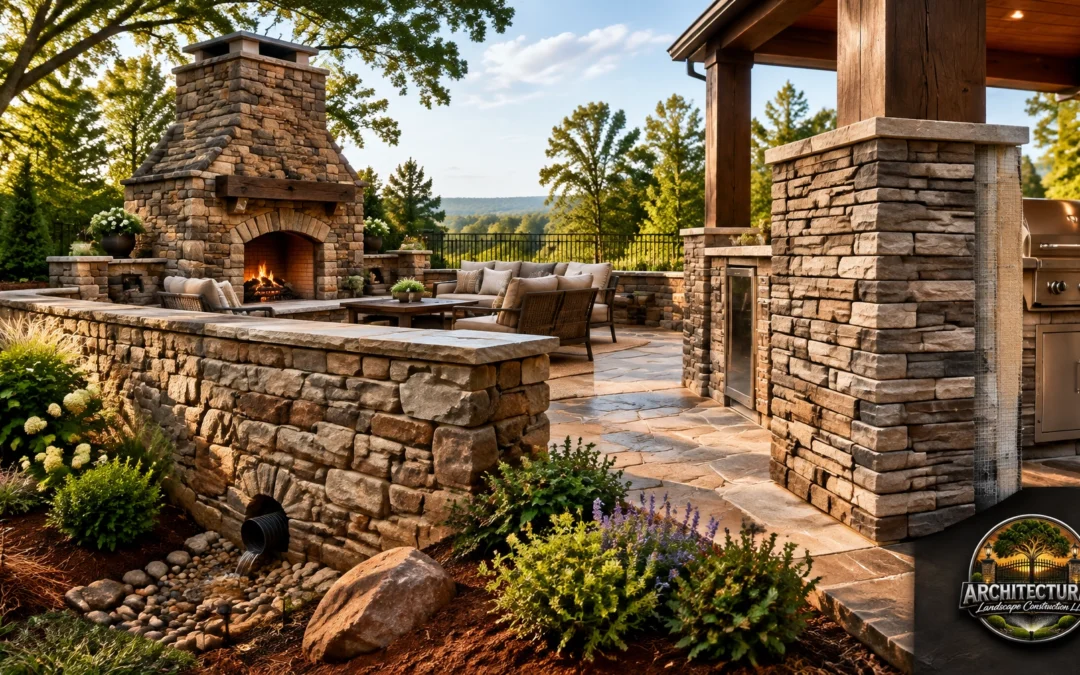
Natural stone offers variation, depth, and an unmistakable sense of permanence. Veneer may still contribute beautifully to the surrounding vertical elements, such as a seat wall, outdoor kitchen base, or fireplace surround.
Outdoor Kitchens, Fireplaces, and Entry Pillars Need Proper Substrates
Vertical applications are where manufactured stone veneer can be especially effective. An outdoor kitchen can use veneer over a properly built masonry or framed structure, provided the substrate, moisture management, clearances, and manufacturer requirements are appropriate.
The same principle applies to entry pillars and architectural columns. Veneer can create a refined appearance over concrete masonry or another suitable structural core. The core must carry the loads; the veneer provides the finish.
Fireplaces require additional care. Veneer may be suitable around an engineered firebox or outdoor fireplace assembly, but the system must respect noncombustible construction, heat exposure, movement, flashing, and water management. Natural stone can also be used in fireplace construction, but stone selection and detailing must be appropriate for the location and intended heat exposure.
A material can be visually convincing while still being technically wrong for the assembly. Experienced design and installation protect both the appearance and the performance.

Attachment, Drainage, and Moisture Control Define Veneer Performance
Manufactured stone veneer is a cladding system, not a waterproof wall and not a replacement for structural construction. Its success depends on what lies behind it.
For veneer installed over framed construction, the assembly may require a compatible weather-resistive barrier, drainage plane, metal lath, scratch coat, mortar, flashing, and weep or drainage provisions. Over concrete or masonry, the substrate must be clean, sound, properly bonded, and compatible with the selected system.
Important details include:
- Keeping veneer clear of soil and persistent splash-back
- Preventing water from being trapped behind the cladding
- Flashing transitions, penetrations, and roof-wall intersections
- Fully bedding units where required to reduce concealed voids
- Using mortars and materials rated for exterior exposure
- Following the manufacturer’s installation requirements
- Protecting horizontal ledges and caps from collecting water
Natural stone masonry also requires disciplined joints, suitable mortar, sound foundations, drainage, and appropriate caps or drip edges. Natural material does not eliminate the need for technical precision.
Aesthetic Character and Repairability Matter
Natural stone offers variation that is difficult to reproduce. Each piece carries its own color, grain, edge, and texture. Skilled placement creates a composition that feels rooted in the land rather than applied to it. For homeowners seeking distinctive hardscape design Arkansas, that irregularity is often central to the desired result.
Manufactured veneer provides consistency and design flexibility. It can make vertical elements lighter, easier to shape, and visually cohesive with existing architecture. It is often a sensible choice for a façade, pillar, kitchen base, or fireplace surround where the substrate is already structurally sound.
Repairability is project-specific. Natural stone can sometimes be selectively removed, reset, or replaced, especially when the original masonry was thoughtfully assembled. Veneer repairs may require matching a discontinued profile, color blend, or weathered finish. In either case, keeping spare material and documenting the original product can make future maintenance easier.
Routine care for both systems may include gentle cleaning, attention to mortar joints, control of irrigation and runoff, removal of organic growth, and inspection after severe weather. Sealers should never be treated as a substitute for sound drainage and construction.

The Smarter Investment Is Project-Specific
Choose full-depth natural stone masonry when the feature is:
- Retaining soil or supporting a grade change
- A heavily used patio, stair, or walkway
- Exposed to concentrated loads or substantial weathering
- Intended as a defining architectural or legacy element
- Dependent on authentic stone texture and hand-selected composition
Consider manufactured stone veneer when the feature is:
- Primarily vertical and non-load-bearing
- Built over a properly engineered masonry or framed substrate
- Part of an outdoor kitchen, pillar, fireplace, or architectural wall
- Designed with appropriate drainage and moisture control
- Better served by a lighter, more uniform cladding system
The most successful landscapes often use both materials strategically. A natural stone retaining wall may anchor the property, while carefully selected veneer adds continuity to an outdoor kitchen or entry feature. The result is not a compromise. It is a coordinated landscape architecture in which every material performs the role for which it is best suited.
Explore our landscape and stone craftsmanship services, view the project gallery, or contact Architectural Landscape Construction LLC to discuss your property, soil, drainage, and design goals. You can also visit our official Fourthwall shop.
A thoughtful consultation allows us to evaluate the site and recommend a material strategy that respects Arkansas conditions while expressing your vision with elegance and restraint.
Architectural Landscape Construction: Legacies in stone since 1987.
Frequently Asked Questions
Is natural stone always better than manufactured stone veneer?
No. Natural stone is generally better for structural, high-traffic, or heavily exposed applications, while veneer can be an excellent choice for properly engineered vertical cladding. The correct material depends on the feature, substrate, drainage, exposure, and design intent.
Can stone veneer be used on a retaining wall?
It can be used as a finish over a structurally adequate retaining wall, but veneer should not be relied upon to resist soil pressure. The retaining system requires its own foundation, drainage, backfill, and structural detailing.
Is manufactured stone veneer suitable for an outdoor kitchen in Arkansas?
Yes, in many cases. The outdoor kitchen must have a suitable substrate, proper moisture management, appropriate clearances, and installation that follows the veneer manufacturer’s requirements. Countertops and structural components require separate consideration.
Why does Arkansas clay soil affect stone construction?
Clay-rich soil can change volume as moisture conditions shift. Without proper excavation, base preparation, compaction, and drainage, that movement can contribute to settlement, heaving, or pressure against walls and paving.
Does natural stone eliminate freeze-thaw concerns?
No. Natural stone still requires appropriate material selection, drainage, joint detailing, and installation for exterior exposure. Water trapped in stone, mortar, or the supporting assembly can contribute to freeze-thaw damage.
Which material requires less maintenance?
Neither material is maintenance-free. Both benefit from proper drainage, gentle cleaning, healthy joint conditions, and protection from persistent runoff or irrigation. Maintenance requirements depend on the specific stone, installation system, exposure, and surrounding landscape.
How do I choose between natural stone and veneer for my project?
Begin with the function of the feature rather than the finish. A professional evaluation should consider soil, grade, drainage, substrate, weather exposure, structural demands, architecture, and the level of natural variation you want in the completed landscape.
Recent Comments