
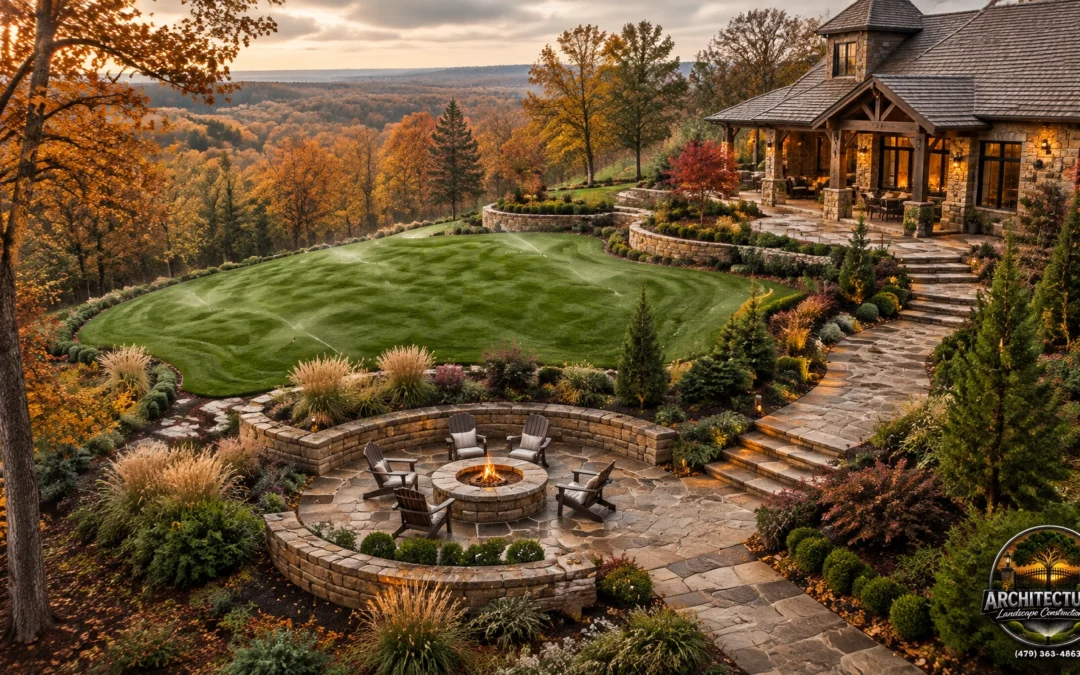
Before Arkansas reaches its first hard freeze, shut down and winterize your irrigation system to remove standing water from pipes, protect backflow and valve assemblies, and prevent saturated soil from stressing stonework, footings, planting beds, and roots. A disciplined fall shutdown reduces the risk of cracked components, heaving sprinkler heads, split lines, washed-out mulch, and expensive spring repairs, while preserving the elegant, tranquil condition of the landscape you have invested in.
Arkansas Requires More Than a Calendar Reminder
Irrigation winterization should be guided by your local forecast, not a fixed date. The National Weather Service notes that freezes often arrive by the last week of October across northern and western Arkansas, while other regions may remain frost-free until November. In Northwest Arkansas, homeowners in Fayetteville, Springdale, Rogers, Bentonville, and Bella Vista should begin planning after the first frost and complete winterization before a hard freeze is forecast.
Little Rock and Central Arkansas generally have a later window, but freeze-thaw swings still make preparation essential. Check your local forecast and water provider before scheduling work.
Arkansas landscapes also contend with clay-heavy, sometimes expansive soils. These soils hold moisture, drain slowly, and can swell when wet or shrink as they dry. With roughly 47 to 50 inches of annual rainfall in many Arkansas communities, irrigation is not the only source of soil moisture, but it can intensify wet conditions around pipes, stone patios, retaining walls, and footings.
For background on regional frost and freeze dates, consult the National Weather Service Arkansas frost and freeze information.
The Sequential Fall Irrigation Shutdown Checklist
1. Reduce the schedule before shutting the system down
As temperatures fall and plant growth slows, adjust the controller’s seasonal percentage, shorten run times, and reduce watering frequency. Established turf and mature plantings typically require less supplemental irrigation in late fall, especially after consistent rainfall.
Do not assume every zone should be treated identically. Turf, ornamental beds, newly planted trees, and evergreen specimens have different moisture requirements. Continue appropriate hand watering for newly established plants when conditions demand it, but disconnect and drain hoses before freezing weather.
If you live in Northwest Arkansas, confirm current guidance from your city or water provider. Fayetteville, Bentonville, and Rogers may issue voluntary conservation schedules through Beaver Water District, while communities served by other regional systems may impose seasonal schedules or temporary lawn-irrigation restrictions.
2. Walk every zone and inspect every head
Run each zone briefly before shutdown. Walk the entire property and look for:
- Misaligned, clogged, tilted, or sunken sprinkler heads
- Heads spraying toward stone walls, foundations, walkways, or patios
- Standing water around heads or low points
- Broken risers, leaking fittings, and damaged nozzle bodies
- Drip lines pulled above mulch or exposed by erosion
- Uneven coverage that may signal a pressure or valve problem
Mark sprinkler heads and drip-line routes with durable stakes or a simple site map before winter. Dormant turf, fallen leaves, and mulch can conceal components until spring maintenance begins. Clear visibility now protects the system from accidental damage during pruning, bed renovation, or snow and ice removal.
3. Protect the backflow preventer
The backflow preventer is one of the most vulnerable and valuable components in the system. Shut off the irrigation supply according to the system design, then drain the assembly using its test cocks or manufacturer-approved procedure.
Do not simply wrap a full backflow device and assume it is protected. Trapped water can freeze, expand, and crack internal chambers or exterior fittings. Insulation can help moderate temperature, but it does not replace proper draining.
Because backflow assemblies vary, follow the manufacturer’s instructions and local plumbing requirements. When in doubt, have the assembly handled by a qualified irrigation professional.

4. Inspect valve boxes and manifolds
Open each valve box and remove leaves, sediment, and standing water where practical. Inspect the manifold, wire connections, fittings, and valves for leaks or damage.
A valve box should remain accessible and should not become a miniature pond. If water consistently collects inside it, investigate the surrounding grade and drainage. A damaged lid, buried box, or unstable soil condition can turn a simple spring startup into a difficult excavation.
This is also the time to document zone names and valve locations. A clear map is a small but valuable part of long-term property stewardship.
5. Choose drain-down or compressed-air blowout correctly
A drain-down system relies on gravity and properly placed drains to remove water. It may work for systems designed with automatic or manual drains, but it does not guarantee that every low point, valve, lateral, or backflow component is empty.
A compressed-air blowout forces water from the mainline and lateral lines through the sprinkler heads. Each zone should be activated separately, and air should be introduced through the correct blowout port. The objective is to remove water without overstressing pipe, fittings, heads, or valves.
Pressure must follow the pipe and component manufacturer’s specifications. Many poly systems are commonly blown out within a range around 50 to 80 psi, but homeowners should never treat that range as universal or exceed the lowest-rated component. Excessive pressure can damage the system and create a hazard.
A professional shutdown includes:
- Closing the main irrigation supply
- Connecting air at the approved access point
- Running each zone independently
- Removing water until only a light mist remains
- Draining and protecting the backflow preventer
- Rechecking low points, drip zones, and exposed fittings
The Sprinkler & Irrigation Systems in Arkansas guide provides additional context on design, smart controllers, and water conservation.
6. Set the controller and sensors for winter
After the system has been drained or blown out, set the controller to OFF, not merely “rain delay.” A rain-delay setting may expire and allow automatic watering during a freeze.
For smart controllers:
- Confirm the seasonal adjustment is reduced or disabled
- Turn off automatic programs that are no longer needed
- Review soil-moisture sensor thresholds
- Check Wi-Fi connectivity and app notifications
- Record spring restart settings before changing them
Verify that rain and freeze sensors are properly mounted, clean, and communicating with the controller. Sensors are valuable during the growing season, but they are not a substitute for physical winterization. A sensor may prevent a scheduled cycle; it cannot remove water already trapped in a pipe.
Why Drainage Protects Both Irrigation and Stonework
Irrigation health and hardscape longevity are inseparable. Water that remains trapped in Arkansas clay can create pressure around stone patios, seat walls, retaining walls, footings, and planting-bed edges. Freeze-thaw movement may then heave heads, disturb bedding layers, open joints, and shift shallow features.
The most vulnerable locations are often where irrigation, grade, and masonry meet. A lateral line placed too close to a footing, a poorly directed spray pattern, or an obstructed drainage outlet can keep soil unnecessarily saturated. On a sloped bed, ignoring the outlet at the bottom may allow water to collect behind a wall or wash mulch downhill during heavy rain.
A drainage-first approach directs water away from structures, protects planting roots, and gives stonework a more stable environment. That principle belongs in every thoughtful landscape design Arkansas project and every serious irrigation installation.

Late-Fall Damage That Appears in Spring
Winter damage is often silent. The system may look acceptable when temperatures fall, only to reveal its failures when spring startup begins:
- Cracked backflow assemblies
- Split mainlines or lateral lines
- Frozen valves and damaged solenoids
- Heaving or tilted sprinkler heads
- Leaking fittings beneath compacted clay
- Washed-out mulch and eroded planting beds
- Water collecting against retaining walls or patios
- Drip lines broken by bed work or frost movement
These failures can affect more than lawn coverage. They can undermine planting health, stain or settle hardscape, and force repairs precisely when spring construction schedules are busiest.
What Not to Do Before the First Hard Freeze
Avoid these common mistakes:
- Do not skip the blowout when the system is not designed for a complete gravity drain-down.
- Do not leave the controller on automatic. A late cycle can refill lines after winterization.
- Do not overwinter with a full mainline. Trapped water expands and places stress on fittings and assemblies.
- Do not rely only on insulation. Insulation slows freezing; it does not drain the system.
- Do not ignore the drainage outlet at the bottom of a sloped bed. Blocked outlets can saturate soil behind masonry and wash away mulch.
- Do not spray directly against stonework or foundations. Repeated moisture can contribute to movement in clay-heavy soil.
A Yearly Stewardship Rhythm for Arkansas Properties
A well-designed landscape is not finished when construction ends. It is stewarded through the seasons. Fall irrigation shutdown belongs alongside spring inspection, summer monitoring, and periodic drainage review.
Whether you are planning sprinkler system installation Arkansas, evaluating retaining walls Arkansas, or considering a broader hardscape design Arkansas transformation, irrigation should be coordinated with grading, planting, masonry, and drainage from the beginning.
Architectural Landscape Construction LLC has served Arkansas since 1987. We are home to two of Arkansas’s few true master stone masons, combining traditional craftsmanship with innovative design to create enduring outdoor spaces. Explore our services, view the gallery, or visit the Legacy Hub shop for practical resources such as the Winterization Protocol.
If you would prefer to have your shutdown reviewed and completed by a professional team, we invite you to contact us. Together, we can establish a seasonal stewardship rhythm that protects your irrigation system, plantings, drainage, and master-crafted stonework for the years ahead.
Architectural Landscape Construction: Legacies in stone since 1987.
Frequently Asked Questions
When should Arkansas homeowners winterize an irrigation system?
Begin planning after the first frost and complete the shutdown before the first hard freeze. Northern and western Arkansas can freeze by the last week of October, while Central Arkansas may freeze later. Use your local forecast rather than relying on a fixed calendar date.
Is draining enough, or does a sprinkler system need a blowout?
It depends on the system’s design. Some systems have effective manual or automatic drains, but gravity may not remove water from every low point. A professional blowout is generally the more reliable method when the system is not specifically designed for complete drain-down.
Should I leave my irrigation controller on rain delay?
No. After winterization, set the controller to OFF. Rain delay is temporary and may expire, allowing the system to run during freezing weather.
Why is Arkansas clay soil a concern for irrigation and hardscape?
Clay-heavy soil drains slowly and may expand when wet and shrink when dry. Excess irrigation can keep soil saturated near stonework, footings, and planting beds. Freeze-thaw cycles can then contribute to heaving, settlement, and drainage problems.
Can Architectural Landscape Construction help with irrigation shutdown?
Yes. Our team can review irrigation zones, backflow protection, valves, drainage, planting beds, and adjacent masonry as part of a professional seasonal stewardship plan. We also provide landscape construction Arkansas and custom landscape design services in Arkansas for properties where irrigation, drainage, planting, and stonework must perform as one composed environment.
Recent Comments