

Choosing landscape stone is not simply a matter of selecting a color you like. The right material must respond to Arkansas’s freeze-thaw cycles, expansive clay soils, intense summer heat, heavy rain, and the architectural character of your home.
For homeowners in Fayetteville, Bentonville, Rogers, Springdale, Bella Vista, and Little Rock, the central question is often whether to choose locally sourced Arkansas stone: such as limestone, sandstone, flagstone, or fieldstone: or import a material such as bluestone, travertine, granite, or Texas limestone.
The short answer is this: native Arkansas stone is often the most natural and cost-conscious choice, while imported stone can provide a more specific color, texture, or performance profile. Neither category is automatically superior. The quality of the stone, the application, and the installation are what determine whether your landscape becomes a lasting legacy or an ongoing maintenance concern.
Arkansas Stone Offers Regional Character and Practical Value
Arkansas has a distinguished tradition of producing natural dimension stone. According to the Arkansas Geological Survey, limestone and sandstone are used throughout the state for both interior and exterior applications, with flaggy sandstone quarried in several western and north-central Arkansas regions.
Local stone has an immediate aesthetic advantage: it belongs here. Its earthy grays, warm buff tones, weathered edges, and organic variation harmonize naturally with Arkansas vegetation, red clay soils, wooded lots, and regional architecture.
Locally sourced stone may also reduce freight costs and simplify material availability. Fieldstone and rough sandstone can create a relaxed, naturalistic setting, while sawn limestone can produce a more formal and architectural finish. The material can feel established from the first day, as though it has always belonged to the property.

Imported Stone Provides Distinctive Performance and Design Flexibility
Imported stone expands the design palette. It can provide a very specific color, finish, thickness, or degree of uniformity that may not be available from a local quarry.
- Bluestone offers blue-gray color, crisp edges, and a refined appearance for formal patios, walkways, steps, and terraces.
- Travertine is known for its warm tones, naturally formed voids, and comparatively cool surface under direct summer sun, making it attractive around pools and barefoot-use areas.
- Granite provides exceptional hardness, abrasion resistance, and low absorption for demanding applications.
- Texas limestone can deliver warm, elegant tones, but its performance varies considerably by quarry and grade.
Imported materials may command a higher installed price because of freight, special-order availability, fabrication, or more exacting layout requirements. That premium can be worthwhile when a particular architectural effect is central to your design. However, imported does not automatically mean more durable, and native does not automatically mean less refined.
Durability Depends on the Stone’s Properties: not Its Passport
Arkansas landscapes experience moisture, heat, soil movement, and periodic freezing. A stone’s ability to perform in this environment depends on measurable characteristics such as absorption, density, compressive strength, flexural strength, and abrasion resistance.
The natural stone durability guidance from Coldspring explains why granite, limestone, and sandstone should not be judged by appearance alone. Even two stones within the same category can perform very differently.
Local Limestone
Dense Arkansas limestone can be an excellent choice for patios, walls, steps, veneers, and garden structures. Its lighter colors can remain more comfortable in summer sun than darker materials. However, softer or more porous limestone may be vulnerable to moisture intrusion and freeze-thaw damage if installed with poor drainage.
Local Sandstone and Flagstone
Arkansas sandstone offers rich texture and a distinctly regional character. It is particularly effective for naturalistic paths, garden walls, terraces, and rustic outdoor rooms. “Flagstone” describes a form and application rather than one specific geology, so its durability depends on whether the material is dense sandstone, limestone, quartzite, or another stone.
Thin, layered pieces should not be selected solely for appearance in areas exposed to standing water or repeated freezing. Proper thickness, bedding, drainage, and stone selection are essential.
Fieldstone
Fieldstone creates the most organic visual language. Its irregular shape is ideal for dry-stack walls, natural water features, garden borders, fire features, and rustic patios. It can be exceptionally durable, but its irregularity requires more craftsmanship during layout and installation.
Bluestone
Bluestone is a strong candidate for homeowners seeking a formal, tailored appearance with good performance in Arkansas conditions. Its dense character and natural texture make it appropriate for walkways, patios, stairs, and outdoor entertaining areas.
Travertine
Travertine can be beautiful and comfortable underfoot in the Arkansas summer, especially around pools. Its natural pores and voids, however, require careful installation and maintenance. It should be used where drainage is reliable and ponding water is unlikely.
Granite
Granite is one of the most durable options for high-traffic paths, steps, driveways, outdoor kitchens, and heavily used gathering spaces. It resists heat and abrasion exceptionally well, although darker granite can become hot in full sun and its material and fabrication costs are typically among the highest.
Native and Imported Stone: A Practical Comparison
| Stone | Durability in Arkansas | Aesthetic character | Relative cost | Best applications |
|---|---|---|---|---|
| Arkansas limestone | Medium to high, depending on density and absorption | Refined, warm, regional | Moderate | Patios, walls, steps, veneers |
| Arkansas sandstone | Variable; strong when dense and well-drained | Textured, earthy, naturalistic | Moderate | Paths, terraces, walls, garden features |
| Arkansas fieldstone | Strong when properly selected and installed | Organic, irregular, rustic | Moderate material cost; high labor value | Dry-stack walls, water features, borders |
| Imported bluestone | Very good for patios and walkways | Formal, cool blue-gray, tailored | Upper-mid to high | Walkways, terraces, steps, patios |
| Travertine | Moderate; drainage is critical | Warm, elegant, naturally textured | Upper-mid | Pool decks and sheltered patios |
| Granite | Excellent strength and abrasion resistance | Sophisticated, architectural | High | Driveways, steps, outdoor kitchens |
| Texas limestone | Highly variable by grade | Warm, clean, contemporary | Moderate to high | Patios, walls, architectural accents |
These are relative comparisons rather than fixed prices. Your final investment will depend on the stone’s thickness, finish, freight, site access, excavation, base preparation, drainage, edge restraints, layout complexity, and masonry labor.
Cost Is More Than the Price of the Stone
Native Arkansas stone often offers a favorable balance between material cost, freight, and visual integration. Rough fieldstone may be economical to purchase but labor-intensive to shape and place. Precisely cut local limestone may cost more than irregular fieldstone but create a cleaner, more formal result.
Imported stone typically adds transportation and handling costs. Granite may require specialized fabrication. Bluestone may carry a premium for its consistent color and precise dimensions. Travertine can involve additional attention to voids, surface treatment, and maintenance.
The most economical choice is not always the material with the lowest initial price. A durable stone installed over a properly engineered base can be reset or repaired in sections if movement occurs. A poorly selected or poorly installed material may require premature replacement regardless of its original cost.
Clay Soil and Drainage Matter as Much as Material Selection
Arkansas clay soils can expand when wet and contract as they dry. Those movements place stress on patios, walls, steps, and walkways. Freeze-thaw cycles can intensify the problem when water becomes trapped beneath the stone.
Stone should never be placed directly on undisturbed clay. A lasting installation requires:
- Proper excavation and subgrade preparation
- A compacted aggregate base suited to the site
- Positive drainage away from structures
- Appropriate bedding and joint materials
- Correct slope for patios and walkways
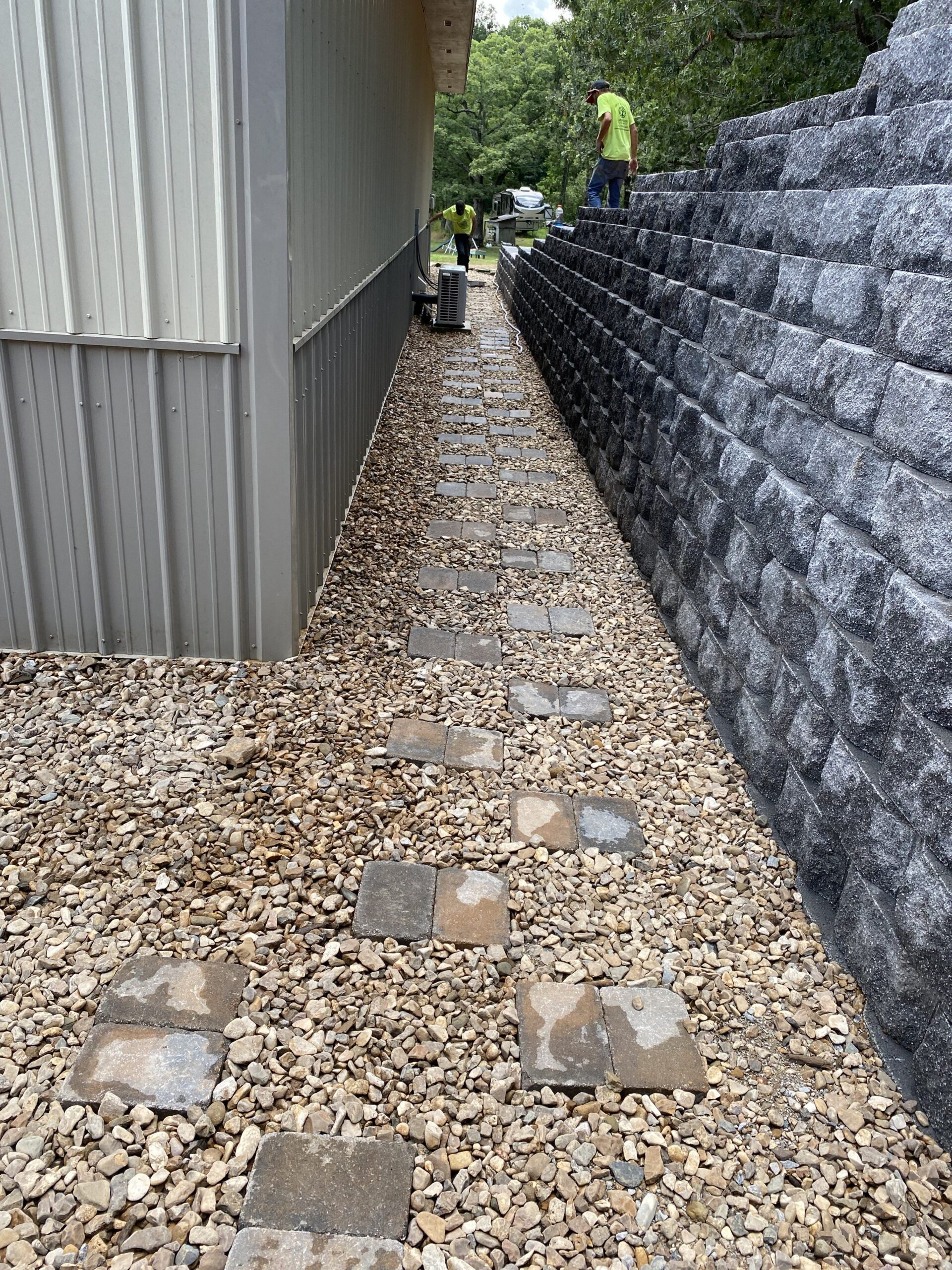
- Reinforcement and drainage behind retaining walls
- Stone thickness appropriate to the intended use
This technical foundation is where master craftsmanship becomes decisive. Stone is not simply arranged on the surface; it is composed in response to grade, water movement, soil behavior, and the way the property will be used.
Which Stone Should You Choose?
For many Northwest Arkansas homeowners, dense local limestone or sandstone offers the strongest combination of regional beauty, value, and versatility. Fieldstone is especially compelling for naturalistic properties, wooded lots, water features, and dry-stack walls.
Choose bluestone when you want a formal blue-gray palette and a more tailored architectural appearance. Consider granite for high-wear locations where maximum hardness and low absorption justify the investment. Select travertine when cool barefoot comfort is a priority and the site can provide excellent drainage. Use Texas limestone only after confirming the specific grade’s absorption and freeze-thaw performance.
Ultimately, the right stone is the one that serves your property’s architecture, your intended use, your budget, and the long-term behavior of your site.
Consult a Master Mason Before You Commit
At Architectural Landscape Construction LLC, we approach stone selection as both an engineering decision and an artistic one. Our two master masons bring a rare depth of traditional skill to every project, from hand-selecting fieldstone to shaping precise joints and composing walls that feel both structurally assured and naturally at home.
Owner and designer Roger Hendrix can help you compare local and imported materials for your specific property in Fayetteville, Bentonville, Rogers, Springdale, Bella Vista, Little Rock, or surrounding Arkansas communities.
For a complimentary consultation, contact Architectural Landscape Construction LLC or call (479) 363-4863. We would be pleased to discuss your site, your vision, and the stone that can carry it forward for generations.
Architectural Landscape Construction: Legacies in stone since 1987.
Frequently Asked Questions
Is native Arkansas stone more durable than imported stone?
Not automatically. Durability depends on the specific stone’s density, absorption, strength, thickness, and installation. Dense Arkansas limestone or sandstone can perform exceptionally well, while a softer imported limestone may require more care. Granite and high-quality bluestone generally offer very strong freeze-thaw and abrasion resistance.
Is local Arkansas stone less expensive?
It often can be, particularly when freight and special-order fabrication are reduced. However, irregular fieldstone may require more skilled labor, and precisely cut local stone can be comparable to imported materials. The total project cost depends on both material and installation complexity.
What is the best stone for an Arkansas patio?
Dense Arkansas limestone, durable sandstone, bluestone, or quartzite-style flagstone can all be excellent choices when properly installed. The best selection depends on sun exposure, drainage, traffic, desired appearance, and whether the patio will be formal or naturalistic.
Is travertine suitable for Arkansas freeze-thaw conditions?
Travertine can be suitable in well-drained applications, especially pool decks and sheltered patios, but its porosity requires careful material selection and installation. It is not the first choice for areas with standing water or severe exposure without a detailed drainage plan.
What should I ask a stone contractor before purchasing material?
Ask for the stone’s absorption, density, strength, freeze-thaw suitability, recommended thickness, maintenance requirements, and intended applications. Also ask how the contractor will prepare the clay subgrade, manage drainage, and address future settlement.
Why does a master mason matter for a natural-stone project?
Natural stone varies in shape, grain, thickness, and weight. A master mason understands how to select, orient, shape, support, and join those pieces so the finished work is both structurally sound and visually intentional. That artistry is especially valuable for retaining walls, steps, fireplaces, water features, and irregular fieldstone construction.
Recent Comments