Waiting for a true master stone mason is the smarter landscaping decision because authentic masonry cannot be rushed without compromising its structure, beauty, and longevity. For discerning Arkansas homeowners, patience protects the investment: every stone is selected, fitted, supported, and drained for the realities of Arkansas clay soil, heavy rainfall, and recurring freeze–thaw conditions. The result is not merely a finished landscape, but a legacy designed to serve the property for generations.
Patience Is the Luxury
In premium construction, speed is rarely the highest expression of value. Precision is.
A production crew can move quickly, install familiar materials, and leave behind a surface that looks complete. A master mason approaches the same property differently. The land is studied. The stone is understood. The wall, terrace, stairway, or outdoor living space is composed with the patience of an artisan creating a permanent work of art.
That distinction matters in Arkansas, where a landscape must respond to more than visual expectations. It must accommodate rolling terrain, intense rain, heavy clay, humid summers, and winter temperatures that repeatedly move above and below freezing.
If your goal is a 100-year property, waiting for the right craftsman is not an inconvenience. It is part of the design.

Master Masons Do More Than Stack Stone
The difference between a master mason and a stone stacker is visible in the finished work, but it begins beneath the surface.
A stone stacker places pieces until a wall appears full. A master mason creates mechanical stability, visual rhythm, and a structure that works with the land.
Hand-Fitting Creates Structural Harmony
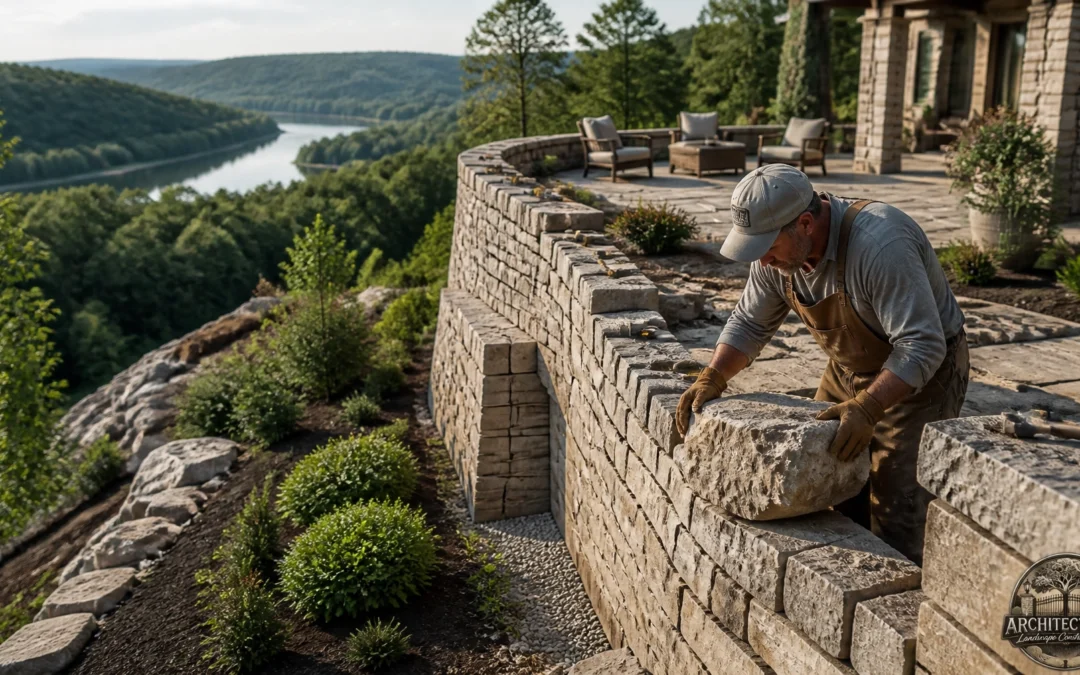
Natural stone rarely arrives in uniform dimensions. Each piece has a unique face, grain, thickness, and center of gravity. Master masonry requires rotating, testing, trimming, and repositioning stones until they bear correctly against one another.
This hand-fitting process creates tighter joints and stronger interlocking courses. Larger, deeper stones are typically placed where they provide the greatest stability, while joints are staggered to prevent weak vertical seams. Through-stones and carefully selected tie stones help connect the visible face to the body of the wall.
The result feels organic because it is. The wall appears to have emerged from the landscape rather than being imposed upon it.
Batter Gives a Wall Quiet Strength
A properly built retaining wall is not always perfectly vertical. Many traditional gravity walls use a measured backward lean, known as batter, to help the structure resist the pressure of the soil behind it.
Batter must be consistent. It is established with layout lines, profiles, levels, and frequent visual checks as the wall rises. An inexperienced crew may allow the face to drift outward course by course. A master mason understands that a subtle, controlled lean contributes to both structural integrity and timeless proportion.
Base Preparation Determines Longevity
The visible stone is only as reliable as the foundation beneath it.
Before the first course is placed, the site must be excavated through organic material, roots, loose fill, and soft subgrade. The base must be shaped, leveled, and compacted in appropriate lifts. Depending on the site and wall design, a properly prepared granular foundation may be required to create a stable bearing surface and reduce differential movement.
This work is not glamorous. It is the quiet discipline behind an elegant result.
Drainage Is Part of the Artistry
Water trapped behind a wall can create hydrostatic pressure, saturate the soil, soften the base, and accelerate movement. In Arkansas, clay soil makes this concern particularly important because clay drains slowly and can hold water against masonry.
A durable wall may require a continuous drainage zone of clean, angular stone, a perforated drainpipe at the base, geotextile separation, appropriate grading, and a safe discharge point. Rigid masonry may also require weep holes or other designed outlets.
The finest stonework does not simply hold back the earth. It gives water a deliberate path to leave.
Arkansas Conditions Make Shortcuts Expensive
Arkansas has a humid subtropical climate, but “mild winter” does not mean “no winter stress.”
The National Weather Service’s 1991–2020 normals for Little Rock show average January temperatures of approximately 50.5°F for the high and 30.9°F for the low, with about 3.5 inches of precipitation. February averages approximately 55.2°F for the high and 34.2°F for the low, with nearly 4 inches of precipitation. Those daily temperature swings create regular opportunities for wet materials and saturated soils to freeze and thaw.
Arkansas Cooperative Extension also notes that clay-heavy soils can drain poorly and that drainage problems should be resolved before planting or building. Clay expands when wet and contracts as it dries. When moisture is trapped beneath a patio or behind a retaining wall, seasonal movement can become a persistent structural force.
Shortcuts may include:
- Placing stone directly on inadequately prepared clay
- Using native clay as the primary drainage medium
- Omitting a properly sloped drainpipe
- Failing to separate drainage aggregate from soil fines
- Ignoring the wall’s batter and overall load
- Selecting stone for appearance alone rather than strength, depth, and bearing characteristics
The initial savings can be quickly erased by leaning walls, displaced pavers, cracked joints, erosion, pooling water, or expensive reconstruction. The true cost is not the shortcut itself. It is paying twice while losing years of enjoyment and confidence in the property.
How to Choose a Landscaping Contractor for Stonework
When considering stone masonry contractors in Arkansas, ask questions that reveal process rather than sales language.
Ask Who Will Actually Build the Masonry
Some firms sell a highly crafted result but subcontract the stonework to a general production crew. Ask whether the advertised mason will personally oversee and execute the work.
At Architectural Landscape Construction LLC, two of Arkansas’s few true master stone masons work on every project we take. Their involvement is not reserved for a consultation or a final inspection. Their hands and judgment remain part of the project from stone selection through final fitting.
Ask How the Site Will Be Prepared
A credible contractor should be able to explain the proposed excavation, base, compaction, drainage, backfill, and discharge strategy in clear language. If the conversation focuses only on the visible stone and not on the foundation, proceed carefully.
For tall, heavily loaded, or unusually complex retaining structures, site-specific engineering or geotechnical consultation may also be appropriate.
Ask How Stone Will Be Selected
A master artisan considers the stone’s color, grain, thickness, face, weight, and relationship to neighboring pieces. The objective is not random variety. It is a composed palette that complements the home, topography, and surrounding planting.
This is where custom landscape design services in Arkansas become essential. The masonry should support the larger vision rather than appear as an isolated installation.
Ask to See Completed Work
Review projects that demonstrate more than attractive materials. Look for controlled lines, natural transitions, coherent joints, integrated steps, proper proportions, and the way the work meets the land.
Our gallery offers a view into the possibilities of master-level landscape construction, from inviting terraces to enduring stone features.
Every Stone Should Serve the Property
The right mason does not begin with a trend. The work begins with the character of the property.
A stone retaining wall may create usable terraces on a sloping site. A carefully fitted patio may become the architectural heart of the garden. A stone stairway may make an overlooked portion of the property accessible and serene. An outdoor kitchen may transform entertaining from an occasional activity into a daily ritual.
For homeowners exploring outdoor living spaces Arkansas, the goal should be more than adding square footage outside. It should be creating a sequence of experiences: arrival, transition, gathering, reflection, and return.
Thoughtful landscape design Arkansas homeowners can live with for decades must balance function and emotion. It must guide movement, manage water, frame views, and create an atmosphere of tranquility without sacrificing structural discipline.

Two Master Masons on Every Project
Architectural Landscape Construction LLC has served Arkansas since 1987. Our practice is grounded in a simple conviction: outdoor spaces deserve the same level of thought, proportion, and craftsmanship as the homes they surround.
We are proud to have two of Arkansas’s few true master stone masons working on every project we take. This established positioning is not a marketing flourish. It reflects the rarity of traditional masonry expertise and our commitment to keeping that expertise directly connected to the work.
Traditional craftsmanship provides the discipline. Innovative design provides the vision. Together, they allow us to create elegant, durable landscapes that feel personal to the property and enduring in character.
For homeowners researching retaining walls Arkansas, stone terraces, patios, outdoor kitchens, and complete landscape transformations, the most important decision may be choosing quality over immediacy.

Waiting Protects the 100-Year Legacy
A legacy property is not defined by how quickly it was completed. It is defined by how gracefully it continues to serve.
The landscape you build today may welcome your family, host important celebrations, frame future additions, and become part of the property’s identity for generations. A wall that remains stable, a patio that settles beautifully, and a stone path that develops a distinguished patina all contribute to that inheritance.
If you are willing to wait for a master mason, you are choosing more than craftsmanship. You are choosing fewer compromises, greater confidence, and a more enduring relationship between your home and the land.
We invite you to begin with a thoughtful consultation about your property, priorities, and long-term vision. You may also explore the Legacy shop, including the Legacy Stone Course, for a deeper look at the philosophy behind traditional stone craftsmanship.
Architectural Landscape Construction: Legacies in stone since 1987.
Recent Comments